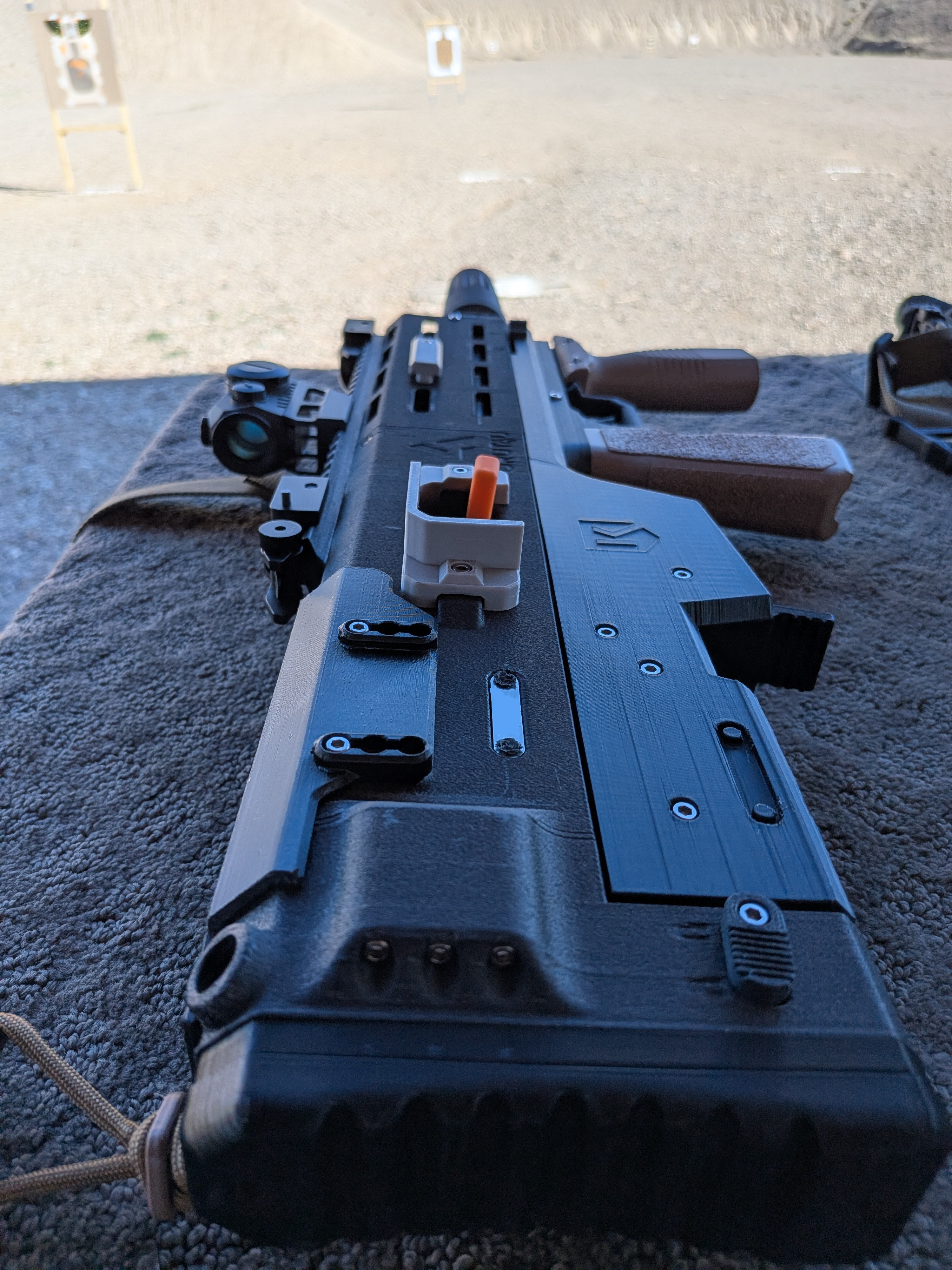
Given that first class packages don't identify their contents and the state can't routinely examine USPS mail, I'm not sure how Cali thinks they can enforce it. But at the very least you could get Send-Cut-Send to laser cut rail blanks and use your own bending jigs to form them. The bending jig models are available on Odysee.
Kopsis
The creep tendency of PLA+ often leads to problems with magazines. Sten are particularly problematic since spacing of the feed lips when new leaves no margin. The only long term reliable Sten mags I've printed were PPA-CF and PET-CF. I suspect Siraya's new PET-GF would also work well.
Take other people's print temps with a grain of salt. Extruder thermistors aren't individually calibrated, different nozzle types have different heat transfer efficiency, and high volumetric rates reduce effective filament temperature due to reduced heating time.
Start with the manufacture max and run some tests at elevated temperatures to see if it results in any improvement in layer adhesion. You don't need sophisticated test apparatus, just print some "snap sticks" and see if you can feel a difference breaking them.
I think your HDT numbers are Fahrenheit. Siraya's datasheet says 122°C annealed (78°C without annealing). Impact strength isn't great and it's worse if you anneal it, but there's still plenty of stuff it can be used for.
Looks good! I really don't have a need for PET-GF right now, but $34.29 with free shipping?! That's just too good to pass up.
It's more than just scaling the bolt. Heavier bolt means heavier recoil springs. Heavier recoil springs means larger/stronger receiver. Magwell and magazines also have to change for each caliber. Magazine design is one of the most difficult parts of creating a self-loading firearm. It's easy to make one that functions; it's hard to make one that functions reliably (even when using an existing design as a reference). You can "cheat" and rely on commercial mags, but even then you'll usually have to tune the feed geometry since the behavior of a .45ACP cartridge is going to be radically different than something like a 5.7.
There is a 9mm version of the Decker 380 in development right now and despite the cartridge itself being nearly identical just 2mm longer, nearly everything except the fire control system has had to change to some degree.
Though privacy is a concern, Bambu's LAN mode seems to adequately address it (for now). The real concern with Bambu is the lack of freedom to go outside the Bambu ecosystem. You're locked into a walled garden and subject to the whims of the company. They're reasonably benevolent now, but lawsuits or product bans in NY or CA could see them singing a different tune in a not-hard-to-imagine dystopian future.
By contrast, QIDI is happy to let you own the printer that you bought. You can firewall it and it still works (without special LAN-mode shenanigans). You can use any slicer and it still works (without having to sneakernet files on flash media). You can load alternate firmware (even firmware you built yourself) and it still works (assuming you do it right). If those things are important to you, then they tend to make the QIDI a better overall value.
Tell me you shouldn't be making rifle barrels without telling me you shouldn't be making rifle barrels.
Seriously, give up this project. You don't appreciate the quality and precision that's required, and trying to make a rifle barrel on the cheap is going to get you seriously injured or killed. Buy a barrel for $100 or make a 9mm.
Good info for those who already have Bambu printers. For those that don't, it's worth mentioning that the best solution to avoiding privacy issues with Bambu is avoiding Bambu. Bambu has made it abundantly clear that they do not accept or support your right to decide how to use the printer that you paid for. This isn't about them being Anti-2A, it's about them being anti-user-freedom.
Bambu isn't the only game in town. QIDI, Elegoo, and others make good printers that actually respect your freedom and privacy, integrate seamlessly with Orca Slicer, and won't force you to sneakernet your g-code on fragile SD cards. You can set up your router to block all internet traffic to/from these printers and they'll continue to work perfectly - no mysterious "LAN mode" needed.
Yes, the Bambu printers are marginally easier for the chronically lazy to get decent prints out of. But we've come a long way from the days when the alternative was spending hour-after-hour trying to beat an Ender into submission. And yes, in some cases they will produce prints that are aesthetically better (though the difference is becoming more and more marginal). So if your primary goal is getting likes on Instagram, by all means continue to support the erosion of your right to own your devices. But for me, freedom is a big part of what we do here. If you value that, consider supporting the companies that respect that and avoiding those that don't.
People often have unrealistic expectations for 22LR "suppressor" ammo. It generally has just as much power as conventional ammo (hence just as much "report") but uses a heavier bullet to ensure it remains subsonic. Since most 22LR ammo is already subsonic out of a < 6" barrel, the suppressor ammo buys you nothing in terms of sound reduction.
Note that suppressor ammo sometimes runs a little cleaner and may be overall higher quality/more consistent than bulk ammo, so it's not necessarily a bad choice ... just don't expect it to automatically be more quiet.
Not currently, and that's why you don't see any fully DIY .223/5.56 rifle designs. Making a safe and accurate barrel for a cartridge with a CIP maximum chamber pressure of 430 MPa requires extremely precise tooling that is capable of working very strong steel alloys. Keep in mind that you're also going to need a set of headspace gauges (that's another $100) in order to ensure you have the chamber cut to the correct depth for your bolt. There's a reason why this kind of work is typically only done by professional gunsmiths -- one needs to produce several barrels to amortize the cost of training, tooling, and testing (expect to ruin 2 - 3 barrels while you are getting your process perfected).
I don't know what you're trying to build, but if you're in a place where you can purchase chamber reamers and rifling buttons, I would think just buying a barrel for a fraction of the cost would be a better solution. If you must go the DIY route for some reason, I really think pistol calibers rather than rifle would be a better fit for your knowledge and budget. Pistol calibers open the door to barrel manufacture by electro-chemical machining which is dramatically cheaper than mechanical methods.
Voyager or MLEM on IOS, Voyager, Boost, or Summit for Android will give you a Reddit like GCI experience that's arguably better than Reddit's brain damaged mobile client.